
The Model Is a Line Item Now. Your Integration Is the Lock-In
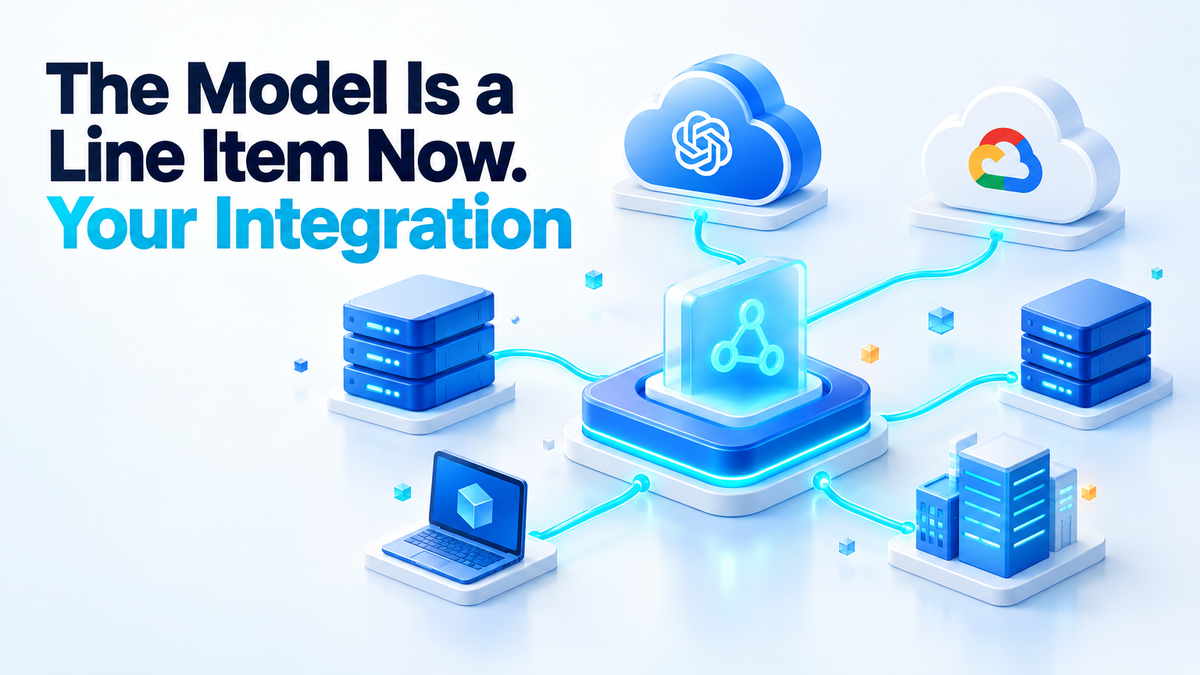
On 21 October 2026, OpenAI announced that it is bringing its frontier models and Codex agentic workflows into Google Cloud's Model Garden. Customers will buy them through the Google Cloud Marketplace. Companies with Google Cloud spend commitments will be able to draw those commitments down to pay for them. OpenAI says general availability is "planned in the coming weeks". For now, access is an invite-only preview. The same post states: "Microsoft remains OpenAI's primary cloud partner."
The wires covered it as a rivalry story. Reuters reported that the deal puts OpenAI's models on all three major US clouds. That follows the end of OpenAI's exclusive distribution arrangement with Microsoft in April 2026, after which Amazon Web Services began hosting the models the very next day. If you build on a rented model, the useful lesson is a quieter one. You can now buy the model at the same counter as your compute, so the model no longer decides whether you can leave. Your code does.
Where lock-in actually lives, seen from a self-hosted LLM
In my own stack, every model call goes through one configured provider and model name, so moving a workload between a rented API and a local server is a config change rather than a rewrite. That setup is also what shows you where the coupling hides. It is rarely in the weights. It hides in three places.
- The base URL and the auth header. Somewhere in your app there is a string like
https://api.openai.com/v1and a header likeAuthorization: Bearer .... The same model on a cloud platform often comes with a different endpoint and a different way to log in, such as a cloud service account instead of a plain API key. Sometimes the region is part of the URL too. If those values are spread across ten files, every move becomes a risky search-and-replace. - The response shape and the model name strings. Code that reads
choices[0].message.contentassumes one API shape. Code with a hard-coded model id assumes that id will keep existing. Both break quietly when you change provider, or when a provider changes its API. One example: OpenAI's request-access page says the Google preview covers the Responses API, which returns its results in a different structure from the older Chat Completions format. - Fine-tuning and eval artefacts. This means fine-tuned models, stored prompt templates, eval sets scored against one model's habits, and tool-calling schemas written in one provider's format. They are the hardest things to move because they look like data rather than code, so nobody lists them as a dependency.
The good news is that the OpenAI-compatible interface has become the common language. llama.cpp's server, vLLM, Ollama and most gateways expose /v1/chat/completions with the same request and response shape. The same client code can therefore talk to a rented frontier model or to a box under your desk, as long as you let it. I covered the hardware layer in how to avoid GPU lock-in. This article is about the layer above that: model access.
The honest case for renting
Rented inference is genuinely better at several things, and pretending otherwise helps no one.
- Frontier quality. You cannot download the current top models as weights. Even if you could, most homelabs could not run them at a useful speed.
- No GPU to own. You have no card to buy, no power bill, no heat in a cupboard and no driver update breaking your stack on a Sunday.
- No model updates to chase. The vendor handles new versions, serving, scaling and uptime.
- Governance and procurement already done. This is the whole pitch of the Google announcement: access controls, data governance and billing inside an environment the company has already approved.
Some workloads should never be self-hosted. If a job needs the current frontier model at frontier quality, rent it. If your compliance already lives inside a cloud agreement, with data residency, audit logs and a signed contract, moving that work to a box in your rack makes your position worse. The goal is portability, not purity.
Where the risk actually sits
Renting comes with four risks, and someone else controls the timing of all of them.
- Price. Per-token rates, rate limits and tier rules can change, and you usually find out by email.
- Terms. Rules on data use, retention and acceptable use get revised, and so do contracts.
- Availability in your region. A model can be offered in one region and not another, or reach one cloud before the others. Even this announcement is staged. OpenAI's own statement is that general availability is planned in the coming weeks. That is a plan stated in an announcement, not a service level you can set a launch date by.
- Version retirement. The vendor can retire or replace a model version on its own timetable.
Most people miss that last one. When a version is retired, a prompt you spent months tuning may start giving longer answers, different JSON or different refusals. An eval you built against the old version stops measuring what you think it measures. Nothing in your repo changed, and your app broke anyway.
A swap test you can run this week
This is the practical part. None of it needs new hardware on day one, and every step pays off even if you never switch provider.
- Find every coupling point. Grep the codebase for base URLs, model ids and provider SDK imports. Something like
grep -rnE 'api.openai.com|base_url|model=|from openai|import openai' .is a start. Add the names of any other SDKs you use. Move every hit into one config file or a set of environment variables such asLLM_BASE_URL,LLM_MODELandLLM_API_KEY. - Route every call through one function. Write one internal function, for example
complete(messages, task), or put a gateway in front of your app. After that, nothing else in the codebase calls a provider SDK directly. Only that function knows the base URL and the model name, and only it knows how to read the response. - Keep a second endpoint configured and tested. Stand up a local llama.cpp or vLLM server that exposes an OpenAI-compatible API. Serve an open-weight model such as
gpt-oss-20b, which OpenAI publishes under Apache 2.0. Point the same environment variables at it and check that your function works with no code changes. - Run a fixed prompt set against both. Pick a small set of real prompts from your own app, including a few awkward ones. Run them against both endpoints and save the outputs with the date and the model id. Run them again whenever something changes upstream and compare the results, so you see a change in behaviour before your users do.
- Write down the fallback order. List the order (primary, secondary, local), which jobs may drop to the local model, which must wait for the frontier model, and who decides to flip the switch. One page in the repo is enough.
The smoke test is the same request against both endpoints. Only the environment changes:
# hosted endpoint: use the base URL your provider documents
export LLM_BASE_URL="https://api.openai.com/v1"
export LLM_MODEL="your-hosted-model-id"
export LLM_API_KEY="your-key"

# local fallback: your own host, port and model name
# export LLM_BASE_URL="http://YOUR-HOST:YOUR-PORT/v1"
# export LLM_MODEL="gpt-oss-20b"

curl -s "$LLM_BASE_URL/chat/completions" -H "Authorization: Bearer $LLM_API_KEY" -H "Content-Type: application/json" -d "$(printf '{"model":"%s","messages":[{"role":"user","content":"%s"}]}' "$LLM_MODEL" "Summarise in one line: disk usage on /var is high")"
Most local servers accept any key unless you configure one. Sending a key anyway keeps the request identical on both sides. I have not run this on your machine, so the host, the port and the local model name are yours to fill in. The local model name depends on how you started the server.
What the local fallback realistically covers
A 20B open-weight model on hardware a homelab already has will not replace a frontier model. It does not need to. Most calls in a typical app are small, boring and high-volume:
- Sorting tickets, emails or log lines into a fixed set of labels.
- Extracting fields from text into JSON.
- Summarising your own logs, notes or meeting transcripts.
- First drafts that a person will edit anyway.
Those jobs run fine on a local 20B model. Keep the frontier model for the hard 5% or so: long reasoning, tricky code and anything a customer sees without review. Think of the local server as the reserve, not the replacement. It keeps the cheap work running when the meter, the terms or the region change, and it gives you a real option when you renegotiate.
You are also not betting on an obscure checkpoint. By Hugging Face's own counters, openai/gpt-oss-20b has about 5.9 million downloads and openai/gpt-oss-120b about 3.1 million. Community GGUF builds for local runners, such as unsloth/gpt-oss-20b-GGUF with about 540,000 downloads, make it simple to load in llama.cpp.
The commercial layer nobody reads
When you can pay for a model out of an existing cloud commitment, the model stops being only a technical choice and becomes a procurement line. Procurement lines get renegotiated, bundled and moved between vendors when contracts come up for renewal. Thomas Kurian, CEO of Google Cloud, described the buyer's side plainly: "We are focused on giving customers a broad selection of models, including those from OpenAI, so they can choose the right model for any given job, helping to deliver optimal quality and lower costs." That is good for buyers. It is bad for any architecture that assumed one provider forever, because the decision to switch may be made in a finance meeting rather than in your repo.
Keep the door open
You do not have to choose between rented and self-hosted. Keep one place that owns the base URL and the model name, use the OpenAI-compatible format on both sides, and keep a local server you have actually tested. Then a price change, a new contract or a retired model version is a config change, not a rewrite.
If you would rather have someone make your AI endpoint portable, or set up a local fallback you can actually test, see the services page. Fiverr: hiteshsaini459 · Upwork: hiteshsaini25