
Own Your Audience Before the Platform Changes the Rules
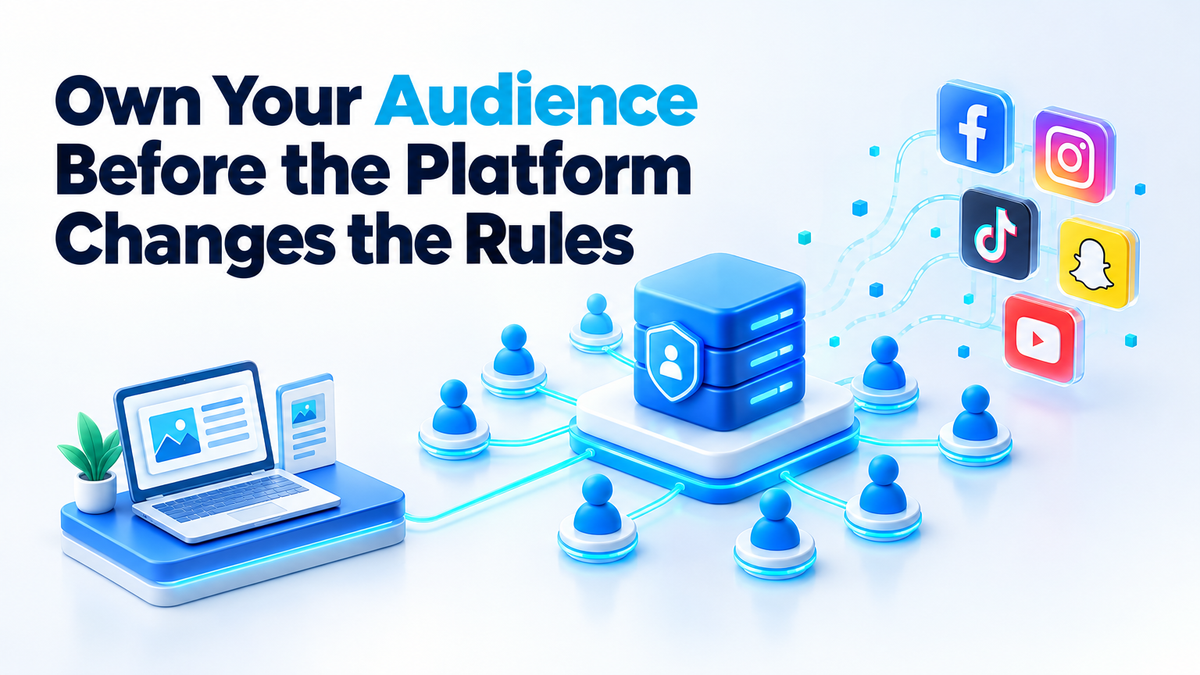
On 20 October 2026, Bloomberg published an interview in which Australia's Communications Minister, Anika Wells, said she expects the government to take Facebook, Instagram, TikTok, Snapchat and YouTube to the Federal Court over how they enforce the country's under-16 social media ban. No case has been filed yet. The platforms say they are complying with the ban.
I publish and host my own work, so I will leave the legal play-by-play to the news desks. What interests me is the part that will still be true after any verdict: a court can fine a platform, but it cannot hand you your audience back.
What the case alleges, and why it is a reason to own your audience
In the interview, given in Sydney, Wells named the five services and said she expected proceedings against all five to move forward. Speaking about the eSafety Commissioner, she said: "Now she has more powers to be able to gather the evidence that she needs to take those five companies to the Federal Court. She's now using those powers to prepare her case."
The commissioner, Julie Inman Grant, opened investigations into platform compliance in March 2026. The government has since expanded her investigative powers, so she can require documents and compel current or former platform employees to answer questions.
The ban has been in force since December 2025. A regulator assessment published in July 2026 found that many children under the age were still able to reach existing accounts or open new ones, and it pointed to ineffective age verification as a main reason.
The platforms tell a different story. Meta said in August 2026 that it had removed access to more than 750,000 Facebook and Instagram accounts in Australia that it judged to belong to under-16s, and that it uses AI to scan posts, bios and captions for clues about age. Meta also argues that the fix belongs lower in the stack: "There should be a single reliable age signal delivered at the operating system or app store level."
The government has raised the maximum penalty under the ban to A$109.2 million (about US$76 million). Separately, according to reports, it introduced the Online Safety Amendment (Digital Duty of Care) Bill 2026 on 15 October 2026, which as proposed would require digital services to assess user risk every year, let users switch off algorithmic feeds, and carry the same A$109.2 million maximum penalty. The government wants it passed by the end of the year, taking effect 12 months later.
Underneath the names and the dollar figures is a dispute about who is allowed to see what, and that is the part that matters to anyone who publishes. The rules about who may see your posts are decided by a government and a policy team at each company. You are not in the room, and your reach is whatever falls out of their argument.
The quiet version happens every month
A Federal Court case is the loud version of this problem. The quiet version is a policy page that gets edited, a limit that appears, a token that expires or a model id that stops being accepted. I have hit every one of these while running my own publishing pipelines.
- Threads and 500 characters. Threads silently rejects a caption longer than 500 characters. The post does not appear, and no error reaches you.
- Instagram stories and 60 seconds. Instagram refuses a story asset longer than 60 seconds with error 2207082, even though the same file publishes fine as a feed post.
- The expired refresh token. An OAuth refresh token expires and a whole channel goes dark. Nothing lands in your inbox to say so. You find out by checking.
- The model id that stopped working. A provider changes which model ids it accepts, and a pipeline that worked last month stops working this month. Whatever that step produced for your posts simply stops arriving.
None of these was announced to me. Each one was a rule change about whether my work reached people, and I learned about every one of them by noticing that something was missing.
Check length and duration before you post, test your tokens on a schedule, and stop treating a success message as proof that something went live:
# characters in a caption (Threads rejects anything over 500)
printf '%s' "$CAPTION" | wc -m

# length of a clip in seconds (Instagram stories refuse anything over 60)
ffprobe -v error -show_entries format=duration -of csv=p=0 clip.mp4
Those checks keep a single post alive. They do not change the underlying fact that the platform can move the line again tomorrow. For that you need a copy of your work, and a list of your readers, that nobody else can switch off.
What to move onto your own box this week
You do not have to leave the platforms. You have to stop keeping the only copy there. Here is the setup I would build, in order.
Your own domain, and a blog as the canonical copy
Buy a domain you control and point it at a blog you host. Ghost, WordPress or a static site generator all work. What matters is that every piece is published there first, and that the platform version links back to it.
The copy on your domain is the canonical one. If an account disappears, the work does not disappear with it, and search engines already know where the original lives.
A newsletter you host, with a list you can export
Email is the closest thing to an audience you own, because the list is a file. Listmonk is a small self-hosted newsletter manager that runs on PostgreSQL. Ghost has a newsletter built in, so members who sign up on your blog are already on your list. Both send bulk mail through an email delivery service, and both let you export your subscribers as a CSV file.
The export is the point. A list you cannot download is still rented.
A full-text RSS feed
Nobody ranks an RSS feed and nobody filters it, so a reader who subscribes gets every post in order. Make sure your feed carries the full post rather than a two-line summary, so a reader never has to go through a platform to finish reading. Ghost serves a feed at /rss/ out of the box.
A sitemap and IndexNow
A sitemap tells search engines what exists on your site, and most blog engines generate one at /sitemap.xml. IndexNow goes a step further and tells participating search engines, such as Bing, the moment a page is published or changed. You host a text file named after your key at your domain root, then send one request per new URL:
curl "https://api.indexnow.org/indexnow?url=https://example.com/new-post/&key=YOUR_KEY"Post the link, not the whole take
On each platform, write a short native line that says why the piece is worth reading, then link to it on your domain. The platform stays a discovery tap, not the tank where your work and your readers are stored.
A link post may travel less far than a full essay pasted into a caption. I accept that trade. Reach on a platform is borrowed, while a reader who lands on your domain and joins your list is someone you can reach again.
How to measure whether you actually own it
Follower counts do not answer this. One honest question does: if your biggest account vanished tomorrow, how many people could you still reach, and how would you reach them?
If the answer is "I would post on my other account", you are still renting. The answer you want is a number from a list you hold, plus the readers who already arrive at your domain without a platform in between. These weekly checks give you that number.
- List size. Count confirmed subscribers on your own newsletter, not followers. Write the number down every week so you can see which way it is moving.
- The export habit. Export the subscriber CSV every week and store it somewhere other than the server it came from, such as your normal backups.
- Direct and RSS traffic. In self-hosted analytics such as Plausible, Umami or GoatCounter, look at the share of visits that arrive direct or with no referrer. Add the requests to your feed from your server logs, because most RSS readers never run your analytics script. Direct traffic is noisy, but the trend tells you whether people come to you on their own.
- The platform-removed test. Open your latest posts in a private window with the big platforms blocked. If a post depends on an embedded Instagram post or YouTube video, it breaks when that account does. Host the image and the video file on your own box.
What a court case can and cannot do
If a case is filed and succeeds, a fine will change how a company behaves. It will not change who owns the pipe. The platform still decides what your followers see, and it will make that decision with its own legal risk in mind, not your reach.
There is a second effect that is easy to miss. The same law that makes a platform remove under-16 accounts also changes who sees adult accounts. To find the under-16s, an age check has to look at everyone, and any system that judges age from clues in posts, bios and captions will sometimes judge wrong. When it does, an adult reader can lose access to your work through no choice of theirs or yours.
The kill-switch post on this blog makes the same point about software: the copy that protects you is the one you control. Audiences work the same way.
Six steps for this week
- Point a domain you own at a self-hosted blog, and publish your next piece there first.
- Set up Listmonk or Ghost's built-in newsletter, add a signup form to every post, and export the subscriber CSV once to prove you can.
- Open your RSS feed in a reader and confirm it carries full posts, not summaries.
- Check that your sitemap is live, then add an IndexNow key file and ping it whenever you publish.
- Change your platform posts to a short native line plus a link to your domain, and add the caption-length and video-duration checks to whatever does the posting.
- Put a weekly reminder in your calendar: write down your list size, export the CSV, look at direct and RSS traffic, confirm every connected account still posts, and test your latest post with the platforms blocked.
If you would rather have someone wire this up for you, see the services page. You can also find me on Fiverr: hiteshsaini459 · Upwork: hiteshsaini25.