
A Hosted AI Is a Channel Someone Else Can Read and Switch Off
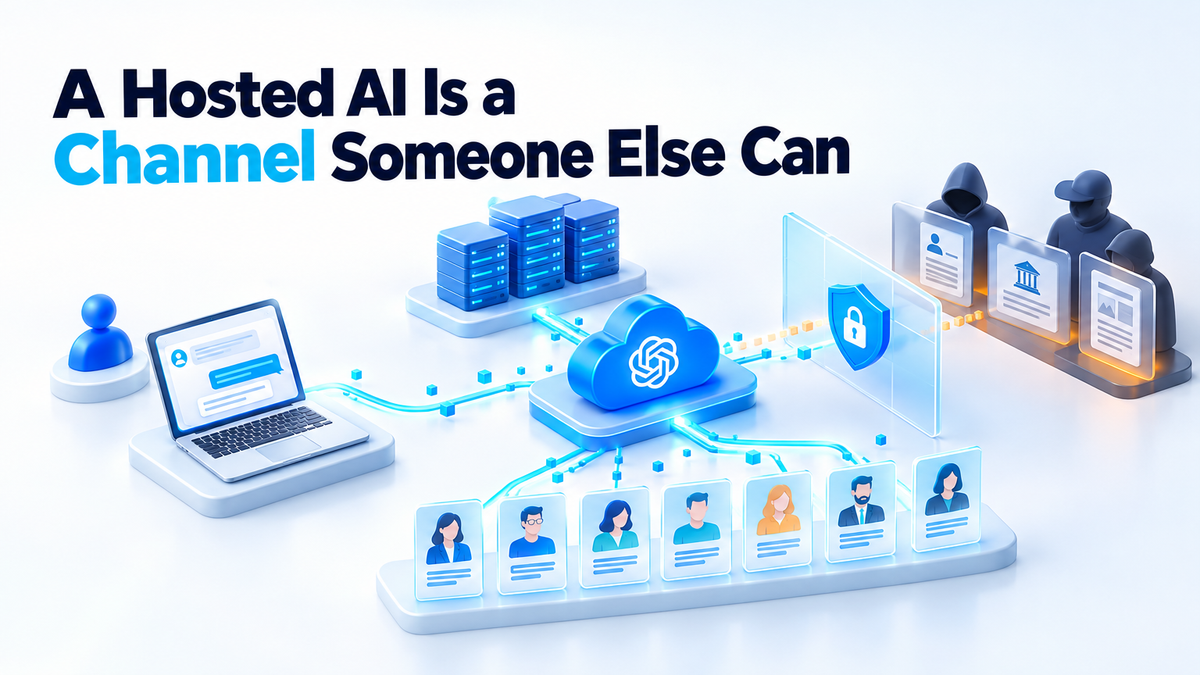
On 8 October 2026, OpenAI published a report called "Disrupting AI-enabled 'false front' operations". OpenAI says it banned two influence operations, one Russia-origin and one Iran-origin, that used its models alongside more traditional techniques to build fake "journalist" and "think tank" fronts. According to OpenAI, the Iran-origin operation ran seven journalist personas that pitched long-form articles to small and medium outlets. The Russia-origin operation appears to have co-opted unwitting people in Latin America to run a think tank on the ground and used AI mostly to draft internal reports.
OpenAI rated the Russian operation Category 5 on the Brookings Breakout Scale, which runs from 1 to 6, and the Iranian one Category 4. OpenAI says it has exposed 30 covert influence operations in the last two and a half years. It also notes that both operations used "questionable or outright deceitful methodologies to exaggerate the operators' effectiveness", so even their own success claims are shaky. The propaganda is not what caught my attention as someone who runs his own stack. What caught it was how the provider knew, and what that same ability means for every hosted account.
Who can read your AI chats, and who can switch them off
The direct answer is the provider. A hosted AI service can review how its service is used, and it can enforce its usage policies by banning accounts. That is exactly how these two operations were found and shut down. Nobody outside OpenAI had to file a complaint first.
It is worth being precise here. I am not saying OpenAI reads every message, and I am not saying it watches its users for sport. I am saying the ability to detect abuse and the ability to see into the service are the same ability. You cannot have one without the other, and it sits under your account just as it sat under theirs.
It is also worth being honest about the evidence. There is no independent evaluation of these specific operations. The categories, the persona count and the reach figures are OpenAI's own claims, made from OpenAI's own view of its own platform. That view exists because OpenAI runs the service.
None of this is a scandal. A provider reading its own traffic is the design, and in this case it did something useful with it. But it is still a fact you should price into what you type. The same goes for the second half of the story. The provider decided, on its own, that certain accounts were done. I wrote more about that side in why a cloud AI agent is a rented dependency. The short version is that access you rent can be withdrawn, and the decision is not yours.
What actually leaves your box when you use a hosted model
When you use a hosted chat or an AI coding tool, more leaves your machine than the sentence you typed. It helps to list it out.
- The prompt. Every word you type goes to the provider's servers to be processed.
- The files you paste or upload. A PDF, a screenshot or a 400-line stack trace all travel the same way.
- The context the tool gathers. Editor assistants often send the open file, nearby files or terminal output so the answer makes sense. You may not see exactly what was included.
- What the provider keeps. Conversations, uploads and usage records may be stored according to the provider's retention policy and your account settings. Read those settings rather than guessing.
For most questions this does not matter. Asking how to write a systemd timer or why a regex fails is public knowledge wrapped in your words. The trouble starts when the material is not yours to share, or would hurt if a stranger saw it.
Here is the kind of thing I keep out of any chat I do not control:
- A client's source code, especially anything covered by an NDA or a contract.
- Credentials of any kind: a
.envfile, an API key, akubeconfig, an SSH private key, a database connection string. - A contract, an invoice or an HR document with names and figures in it.
- An unredacted log file. A raw
access.logfrom nginx can contain IP addresses, email addresses in query strings and session tokens. - Drafts you would not hand to a stranger: a resignation letter, a medical note, a dispute with a landlord.
If you must use a hosted model for one of these, strip it first. Replace real hostnames with example.internal, swap keys for REDACTED, and cut the log down to the ten lines that matter. That habit costs a minute and removes most of the risk.
Running the model where you own it
The other option is to run the model on hardware you control. With a local model, the prompt never leaves the machine. The model cannot report you, and nobody can revoke your access to weights already sitting on your disk.
There are a few practical ways to do it:
- Ollama is the easiest start for one person. It downloads open-weight models and serves them on
127.0.0.1:11434by default, so nothing is exposed to the network unless you change that. - llama.cpp is the engine underneath a lot of local tooling. Use it directly when you want fine control over quantisation, threads and memory.
- vLLM is a self-hosted inference server built for throughput. It suits a team where several people need the same model at once, and it exposes an OpenAI-compatible API, so existing tools can point at it.
Getting a first model running with Ollama looks like this:
ollama pull llama3.1:8b
ollama run llama3.1:8b
The rule that matters is not which tool you pick. It is that the logs live on your disk, and the model can be stopped, copied and audited by you. If you want a record of every prompt, you decide where it goes and how long it stays. If you want no record, you can have that too. I go through a full private setup in self-hosted AI that keeps your data local.
The trade is real, and I will not pretend otherwise. Open-weight models that fit on a single consumer GPU are smaller than the frontier hosted models, and on hard reasoning tasks you will notice. You pay for the compute, in hardware and electricity. You also carry the maintenance: updating runtimes, pulling new model versions, and making sure the server is not accidentally listening on a public interface.
The honest middle: deciding which side of the line a task sits on
Not everything needs to be local. I use hosted models regularly, and for a lot of work they are the right tool. The skill is deciding per task, not picking a side once.
I use two questions:
- How sensitive is the material? Public docs and generic questions are low. Internal code is medium. Credentials, client data and personal documents are high.
- How much quality do I need? Some tasks are fine with a decent 8B model, like summarising, reformatting or writing a shell one-liner. Others really benefit from the strongest model available.
From there the choice is mostly simple:
- Low sensitivity, any quality need: a hosted model is fine.
- High sensitivity, modest quality need: run it locally.
- High sensitivity, high quality need: redact hard and use the hosted model, or split the work so only the generic part leaves your machine.
It is also fair to say OpenAI did the right thing here. If the Iranian operation's articles reached an outlet that, OpenAI says, had almost 2 million Facebook followers as of August 2026, then catching it matters. Abuse detection on a hosted platform is a real public good, and I would rather providers do it than not.
The point is not that hosted AI is dangerous. The point is that it comes with a provider who can see how the service is used and can close your account, and that is a good guarantee for some work and the wrong one for other work. Choose knowingly.
If you want this set up for you
If you would rather have someone stand up a local model and a private AI gateway on your own hardware, with the logs on your disk and nothing exposed that should not be, take a look at the services page.
Fiverr: hiteshsaini459 · Upwork: hiteshsaini25